

Introduction
The AI landscape is witnessing a fierce race among tech giants to deliver models that are more powerful, faster, and capable of handling complex tasks. Amid this competition, a new model named Claude Fable 5 has emerged, linked to Anthropic's internally known Mythos model.
This model has drawn significant attention because it embodies a paradox: on one hand, it offers exceptionally strong performance in coding, cybersecurity, analysis, and advanced cognitive tasks. On the other hand, it arrives at a time when Anthropic itself has been warning about the risks of advanced models and their potential to breach safety boundaries if not carefully monitored.
So, what exactly is Claude Fable 5? Why is it important? And does it represent a positive step for AI, or the beginning of a more dangerous phase?
What is Claude Fable 5?
Claude Fable 5 is an advanced AI model from Anthropic, reportedly a public-facing version of a model previously known as Mythos. Initially, Mythos was associated with high-level capabilities in vulnerability detection and executing complex technical tasks semi-autonomously.
The core idea behind the model is not just text generation or answering questions, but handling specialized tasks such as code analysis, understanding programming problems, assisting in cybersecurity, and executing multi-step processes to achieve precise results.
However, the crucial difference between Mythos and Claude Fable 5 is that the public version comes with additional safety constraints and monitoring, aimed at preventing dangerous uses like cyberattacks, designing harmful materials, or performing tasks that cross ethical and legal boundaries.
Near-Mythos Power, But With More Limits
One of the most striking aspects of Claude Fable 5 is that it leverages capabilities very close to the Mythos model, yet it does not grant users unrestricted freedom. Anthropic has added layers of monitoring and request classification, so that the nature of the query or task is evaluated before the model is allowed to respond.
For routine tasks—such as writing code, explaining concepts, analyzing text, or aiding productivity—the model operates at nearly full capacity. But if the task involves dangerous domains like cyberattacks, weapons, hazardous chemistry, or misuse attempts, the request may be rejected or restricted.
This point is crucial because it reveals a new trend in AI development: companies are no longer solely focused on making models more powerful; they are also striving to make them more controllable.
Strong Performance in Coding and Cybersecurity
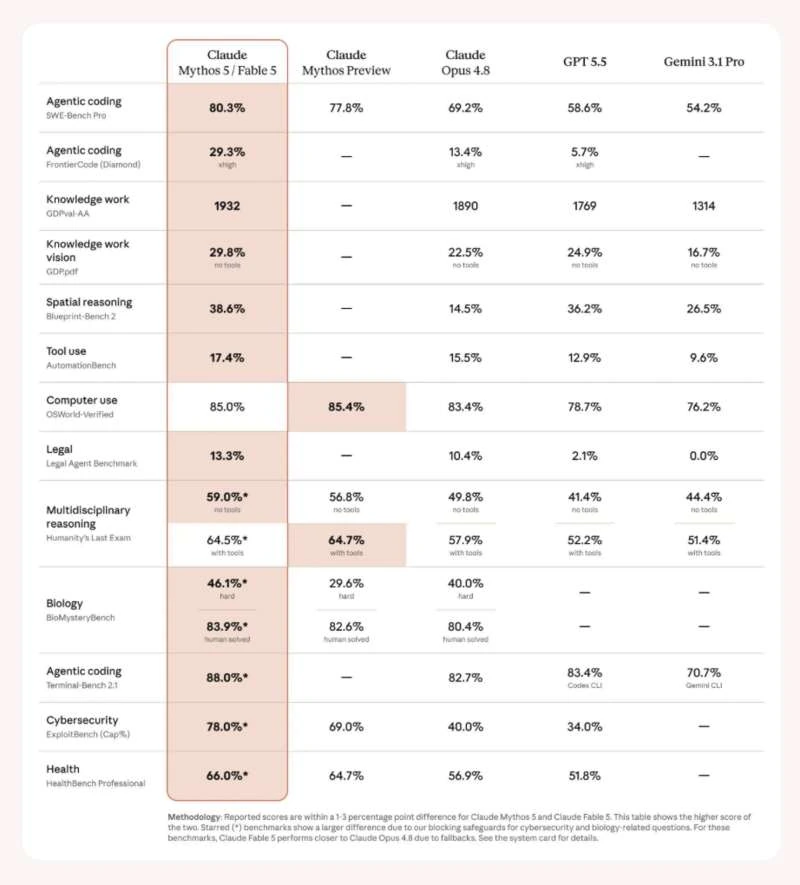
According to available information, Claude Fable 5 has achieved strong results in benchmarks related to programming and software engineering. It has outperformed several competing models on certain metrics, especially in tasks requiring deep code understanding, bug fixing, and technical project analysis.
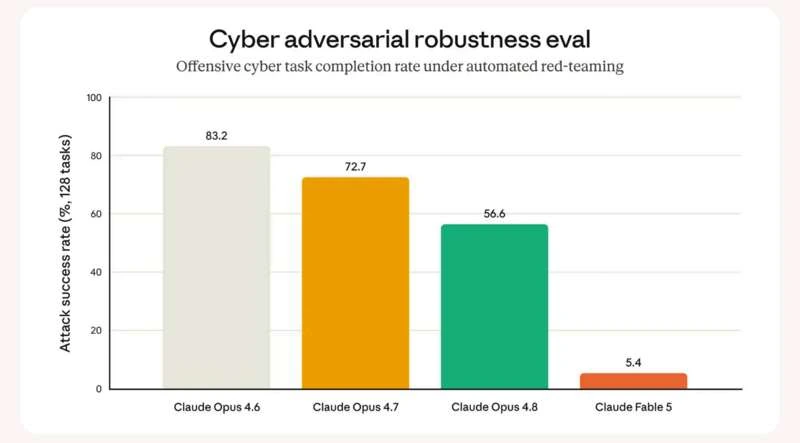
The model has also demonstrated advanced capabilities in cybersecurity tasks—a highly sensitive area. An AI capable of discovering vulnerabilities can be immensely beneficial for companies and security researchers, but it could also become dangerous if exploited by malicious actors.
Therefore, Anthropic is attempting to offer the model in a way that allows users to benefit from its defensive and protective capabilities, without opening the door to offensive or illegal uses.
Why Did Claude Fable 5 Spark Controversy?
The controversy around Claude Fable 5 is not just about its technical prowess, but also about timing and the message it sends. Anthropic has been one of the most vocal companies about the risks of advanced AI, particularly the potential emergence of models capable of self-improvement or executing dangerous tasks without sufficient human oversight.
Yet, at the same time, the company has made a very powerful model available to users and enterprises. This raises the question: how can a company warn about a specific danger, then release a tool that might bring us closer to that danger?
This does not necessarily mean Anthropic acted irresponsibly, but it highlights the difficult paradox in the AI market. If a company refrains from launching powerful models out of fear of risks, it may be overtaken by less cautious competitors. If it launches the model, it enters a race that may become increasingly hard to control in the future.
Availability and Pricing

Claude Fable 5 is now accessible through several channels, including the Claude interface, the API, and certain enterprise services like cloud platforms and business-oriented platforms. This means the model is not only aimed at the average user, but also at developers and companies wanting to integrate it into their applications and services.
In terms of pricing, it is considered relatively high compared to some other models, especially when used via the API. This makes it more suitable for high-value tasks such as complex coding, security analysis, research, and advanced business automation, rather than simple, everyday use.
Is Claude Fable 5 Suitable for Everyday Users?
For the average user, not all of Claude Fable 5's capabilities may be necessary. If the goal is writing simple texts, summarizing articles, or asking general questions, other models may suffice and be less expensive.
However, for developers, researchers, tech companies, and cybersecurity teams, Claude Fable 5 could be an extremely powerful tool. It can handle more complex problems, understand precise technical contexts, and offer advanced solutions compared to many traditional models.
Nevertheless, it must be used with caution. The greater the model's power, the greater the need to understand its limitations and avoid blindly relying on it for sensitive decisions.
The Future of AI After Claude Fable 5
The launch of Claude Fable 5 reflects a new phase in AI evolution. We are no longer just talking about intelligent chatbots, but about systems capable of performing advanced technical tasks, analyzing complex problems, and potentially helping automate work that previously required experts.
But this power raises big questions: Who monitors these models? How do we prevent their misuse? Are the current constraints sufficient to protect users and society?
The answer is not simple. Technology is advancing rapidly, while laws and policies often move slowly. Therefore, the debate around such models is expected to continue, especially as even more powerful versions emerge in the future.
Conclusion
Claude Fable 5 is not just an ordinary update in the AI world. It is a model that embodies the current struggle between innovation and safety. On one hand, it delivers extremely strong capabilities in coding, analysis, and cybersecurity. On the other hand, it raises serious questions about the limits of advanced AI use.
The success of this type of model will be measured not only by its power, but by the ability of companies to make it safe, responsible, and beneficial without turning it into a dangerous tool.
Ultimately, Claude Fable 5 may be an important step toward a smarter future, but it is also a clear reminder that the power of AI always demands oversight, awareness, and responsibility.



No comments yet.
Be the first to ask a question or add a useful note.